

You should spend about 20 minutes on this task.
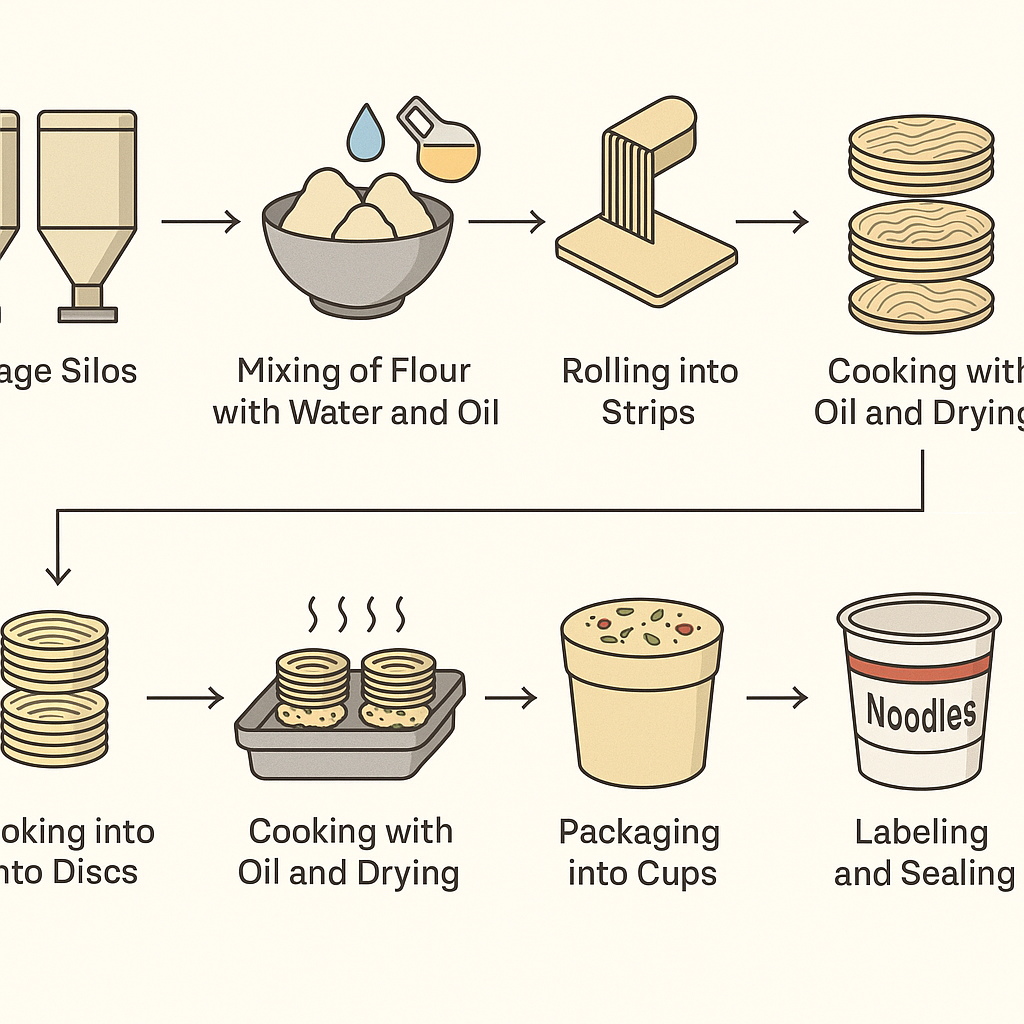
The diagram below shows the process by which instant noodles are manufactured in a factory.
Summarize the information by selecting and reporting the main features, and make comparisons where relevant.
Structure:
The Process diagram illustrates how instant noodles are produced in a factory.
Overall, the process involves eight main stages, beginning with the storage of raw materials and ending with labeling and sealing the finished products for sale.
Initially, flour is stored in large silos before it is mixed with water and oil. The mixture is then rolled into thin sheets and cut into strips. Next, the strips are formed into noodle discs, which are cooked in oil and then dried.
Once dried, the noodles are placed into cups, after which packets of vegetables and seasoning are added. Finally, the cups are labeled and sealed, making them ready for distribution and sale.
Answer:
The diagram illustrates how instant noodles are produced in a factory.
Overall, the process involves eight main stages, beginning with the storage of raw materials and ending with labeling and sealing the finished products for sale.
Initially, flour is stored in large silos before it is mixed with water and oil. The mixture is then rolled into thin sheets and cut into strips. Next, the strips are formed into noodle discs, which are cooked in oil and then dried.
Once dried, the noodles are placed into cups, after which packets of vegetables and seasoning are added. Finally, the cups are labeled and sealed, making them ready for distribution and sale.
In IELTS Academic Writing Task 1, there are 6 main types of questions you can get.
| Type | Example Visual | What You Must Do | Common Skills Tested |
| 1️⃣ Line Graph | 📈 Shows data changes over time (e.g., population from 2000–2020) | Describe trends, increases, decreases, comparisons | Time-related language (rose steadily, fell sharply) |
| 2️⃣ Bar Chart | 📊 Shows quantities across categories (e.g., Internet users by income group) | Compare categories | Comparison language (higher than, similar to) |
| 3️⃣ Pie Chart | 🥧 Shows proportions (percentages of a whole) | Describe percentages and proportions | Fraction and comparison vocabulary (a fifth of, the largest share) |
| 4️⃣ Table | 📋 Data in rows and columns | Summarize key numbers and highlight patterns | Selecting and grouping data logically |
| 5️⃣ Process Diagram | ⚙️ Shows steps of a process (e.g., instant noodles, water cycle) | Explain how something works or is made | Passive voice (is mixed, is heated, is collected) |
| 6️⃣ Map / Diagram (Comparison) | 🗺️ Shows changes in places over time (e.g., a town in 1990 vs 2020) | Describe differences between two maps | Prepositions and change language (was replaced by, expanded into) |